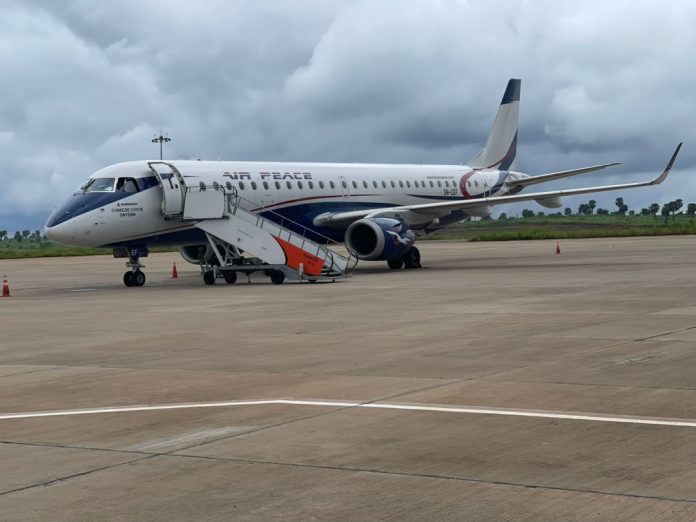


…Conflicting airfield-lighting clearances raise disturbing questions as Air Peace passengers are stranded in Umueri
Why Governor Soludo cannot look the other way
GMA AVIATION DESK
UMUERi, ANAMBRA — The latest operational crisis at the Chinua Achebe International Cargo Airport, Umueri, has exposed what aviation stakeholders describe as disturbing weaknesses in the management and maintenance of critical airport infrastructure under the watch of Airport Manager, Mr. Martins Emeka Nwafor.
The development has raised fresh questions about the competence, maintenance culture and administrative oversight of the airport management, particularly following the failure of runway lighting that disrupted Air Peace operations on August 26, 2026, leaving passengers stranded and exposing the airport to avoidable operational and security risks.
The incident is particularly troubling because available aeronautical records indicate that critical runway and taxiway lighting systems had previously been declared operational.
FOUR HOURS OF DELAY, THEN A FLIGHT THAT COULD NOT LEAVE
The crisis unfolded when an Air Peace flight, 5N-CFM, scheduled to operate to Lagos on August 26, was delayed for approximately four hours before the operation was eventually cancelled.
The immediate problem was the failure of the generator powering the runway lighting system. As darkness descended, the airport could not provide the lighting required for the safe operation of the aircraft.
The situation became even more embarrassing when a rescue aircraft carrying engineers to attend to an Aircraft on Ground (AOG) reportedly arrived at about 1935 hours but could not land because the runway lighting could not be activated.
The aircraft was forced to abort its approach and return. That was not merely an inconvenience. It was a serious operational warning.
WHO DECLARED THE LIGHTS FUNCTIONAL?
Perhaps the most troubling aspect of the incident is the apparent contradiction between the condition of the airport’s lighting infrastructure and aeronautical notices indicating that the facilities were operational.
Aeronautical notices issued through the Nigerian Airspace Management Agency (NAMA) on July 31, 2026, reportedly cancelled previous notices concerning defects in:
- Taxiway edge lighting;
- Runway 06/24 edge lighting; and
- Runway 06/24 centre-line lighting.
In effect, the notices indicated that the relevant systems had been restored to service.
Yet barely weeks later, the airport’s runway lighting reportedly failed when it was critically needed.
The obvious question is: what exactly was repaired, tested and certified as operational?
And, more importantly, who gave the assurance that the defects had been cleared?
There are allegations that NAMA officials relied on assurances from the airport manager, Mr. Nwafor that the faults had been rectified.
If those allegations are substantiated, the matter goes far beyond ordinary administrative inefficiency.
It raises questions about whether maintenance works were properly carried out, independently verified and subjected to appropriate operational testing before the defects were declared cleared.
NWAFOR’S MANAGEMENT UNDER THE SPOTLIGHT
The airport manager, Martins Emeka Nwafor, is now at the centre of growing scrutiny over the airport’s operational performance.
There are longstanding allegations and records reportedly pointing to inefficiencies in the management of critical airport systems, including allegations concerning the handling and functionality of the airport’s Instrument Landing System (ILS), lighting infrastructure and other operational facilities.
Some of these allegations go further, claiming that the management of the facilities has amounted to deliberate or negligent interference with systems essential to efficient airport operations.
Those are serious allegations and must be independently investigated.
But what cannot be dismissed is the recurring operational consequence: airlines face difficulty operating, passengers pay the price, and the airport’s attractiveness as an aviation gateway continues to suffer.
If an airport repeatedly experiences failures in basic operational infrastructure, airlines will naturally factor the resulting risks, delays and additional operating costs into their decisions.
Passengers ultimately bear those costs.
AN AIRPORT THAT SHOULD BE GROWING IS LOSING ITS USERS
The irony is stark.
Anambra is one of Nigeria’s most commercially active states, with a large travelling population and enormous potential for air transportation.
Yet there are growing complaints that many travellers who would ordinarily use the Umueri airport increasingly consider alternative airports, including Akanu Ibiam International Airport, Enugu, Sam Mbakwe International Airport, Owerri, and the Asaba Airport, before completing their journeys to Anambra by road.
That is an economic loss to Anambra.
It means lost passenger traffic, lost airline confidence, lost commercial opportunities and diminished returns on the enormous public investment that produced the airport.
An international airport cannot become a facility that passengers avoid because they are uncertain whether its basic systems will work.
THE AIR PEACE INCIDENT: WRONG AIRLINE, WRONG TARGET
The treatment of passengers during the August 26 incident also deserves attention.
Passengers stranded at the airport reportedly became increasingly agitated, with Aviation Security personnel and law-enforcement agencies deployed as tensions escalated.
The frustration was directed largely at Air Peace personnel.
But if the primary cause of the final cancellation was the failure of the airport’s runway lighting and power infrastructure, then the airline and its staff should not become the scapegoats for a problem originating from airport infrastructure.
Air Peace could not fly an aircraft safely into an airport whose runway lighting was unavailable. That is an aviation safety requirement, not an airline preference. The passengers deserved an explanation.
But the fundamental question must be directed at the facility responsible for providing a safe and operational airfield:
Why did the airport’s runway lighting fail after the relevant defects had reportedly been declared cleared?
GOVERNOR SOLUDO CANNOT LOOK AWAY
This is now a matter requiring the immediate attention of the Anambra State Government and the relevant aviation authorities.
Governor Charles Chukwuma Soludo has a strategic interest in ensuring that the airport becomes a productive economic asset rather than an expensive infrastructure project that airlines and passengers increasingly find difficult to use.
The government should order an independent technical and administrative audit of the airport’s critical systems, particularly:
- Runway and taxiway lighting;
- Generator and backup power systems;
- Instrument Landing System (ILS);
- Maintenance contracts and expenditure;
- Certification and verification of completed repairs;
- Previous NAMA aeronautical notices concerning the airport;
- Records of reported faults and their subsequent clearance;
- Operational disruptions experienced by airlines; and
- The overall performance of the airport’s management.
The audit should establish who did what, when it was done, how much was spent, who certified the work and whether the facilities actually worked after certification.
If wrongdoing is established, those responsible should face appropriate sanctions. If incompetence is established, the government must act accordingly.
ANAMBRA NEEDS A PROFESSIONAL AIRPORT MANAGEMENT, NOT AN AIRPORT IN PERMANENT REPAIR
The central issue is no longer whether another excuse can be found for another operational failure.
The real question is whether the Chinua Achebe International Cargo Airport is being managed with the professionalism, technical competence and accountability expected of a major international gateway.
Mr. Martins Emeka Nwafor must therefore answer the questions arising from this latest failure.
The allegations against him must not be treated as proven facts without due investigation. But neither should they be ignored where documentary records, operational failures and conflicting technical declarations provide grounds for legitimate scrutiny.
Anambra deserves an airport that works. Airlines deserve an airport they can trust. Passengers deserve an airport where they can travel without fearing that a basic generator or runway lighting system will bring operations to a halt.
And the taxpayers of Anambra deserve to know whether the enormous investment in their airport is being protected by competent management.
The August 26 Air Peace incident should therefore be the last straw, not another incident to be explained away.
The Anambra State Government should investigate the management of Chinua Achebe International Cargo Airport immediately and publish the findings.
If Mr. Nwafor is competent, let the records vindicate him. If he has failed, let the records establish it.
And if the investigation establishes negligence, misconduct or corruption, the appropriate authorities must act without fear or favour.
Anambra’s airport cannot be allowed to become a monument to administrative failure.